Up in the sky, shining bright
Little points of light, in the night
...was all that humans knew about stars at one point
of time. With time and patience, knowledge grew. Some of the earliest records
are from around 2300 BC, when the Chinese started naming stars, and 750 BC,
when Babylonians made moon calendars. But soon information started flooding in
and a lot of humans lost track of what was being discovered. Millennia later.
So as Astro Club, we held a lecture, one among a series called Syzygy. Syzygy refers
to a straight line configuration of three celestial bodies. The series will
have lectures on different topics. This one, held on 23rd, was about stars and
a bit of what we know about them. The turnout was decent and included a few
professors as well.
Humans, in
general, have something of a history of being fickle minded when it comes to theories
on how things work, more so in the case of Astronomy. Ptolemy listed
forty-eight constellations and believed in the geocentric theory. Along came Copernicus
to burst his bubble. He came up with a theory that had the Sun at the centre of
the Universe and not the Earth. We now know that neither of them are true. But
at that point of time, the theory faced a good deal of opposition while still
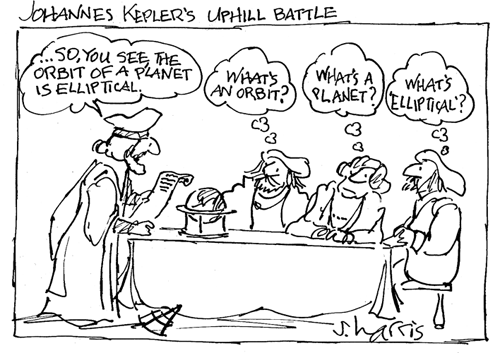
gaining popularity, as it was closer to the truth. Then came Kepler's laws,
which gave us a detailed explanation of the motion of planets, Galileo's
telescope, with which he was able to see Jupiter’s “ears”, Newton laws and
finally, the Messier catalogue. THE MESSIER CATALOGUE which is still the most
famous list of heavenly objects.
Soon enough,
they got bored of just looking at the stars and standing there with their
mouths gaping open. The emphasis then shifted to looking at the physics behind
stars. It went beyond observation and cataloging. Till that time, as far as the
people were concerned, stars were just humongous balls of cotton that had been
set on fire.
 |
| OOH! Look. I’m holding a star! :) |
And that’s when they analyzed Vega’s spectrum. Just like an
excited kid with a prism pointed at the sun, the scientists had a look at the
spectrum caused by light from Vega. And that’s when they went like OMGWTF?! The
spectrum was different from the one that belonged to the sun. So our sun, was
indeed unique, just like every other star out there. Spectroscopy provided a
method of looking into stars, literally. There are three kinds of spectra:
continuous, emission, absorption. Stars were upgraded from fiery cotton balls
to hot balls of gas held together by tremendous gravitational forces. At such
high temperature, the density is no barrier to using ideal gas equations, as
the kinetic energy is still a lot higher than the potential energy. And the best part is, that you don't even have to be a genius to figure out the maths behind it. Sure, you might not have heard of some of the weird theorems and formulae that are used in the process, but down on the ground level, they are all just basic physics that we have all learned at school. Depending
on how the dark or bright lines in a star’s spectrum were placed, you could tell what
elements the star was made out of, the temperature of the star, how fast and
where the star was moving, the density of the star and much, much more.
 |
| The different types of spectra that are used to study star |
The color of stars are classified into 7 spectral types where(ironically)
O, or blue stars, are the hottest and M
and K, or the red stars, are the coolest. Apart from that, stars are also
divided into categories based on their sizes and luminosity. In the 1900s, two
scientists came up with a temperature-luminosity graph for the stars, called
the Hertzsprung, Russel
diagram, or HR for short. They discovered that white dwarfs, giants and
super giants didn't fit in in the same place as most of the other “normal”
stars.
 |
The HR diagram, simplified
|
Naturally, observation and theorems followed and the quest
goes on...
“...it was in the
nature of things that we shall never
know what stars are...”
...will it ever end?

No comments:
Post a Comment