Thursday, September 27, 2012

What is the Question If Dark Energy is the Answer?


       In the good ol’ days, people thought the universe to be just up to the Milky Way. It was in 1922, that Edwin Hubble found that the universe extends beyond the Milky Way. Using the world's largest telescope - Hooker Telescope, he identified the Cephid Variables, a class of very luminous variable stars, in several spiral nebulae. There is a strong direct relationship between a Cephid Variable's luminosity and pulsation period. His observations proved conclusively that these nebulae were much too distant to be part of the Milky Way and were, in fact, entire galaxies outside our own.

On the other hand, Vesto Slipher observed the spectra of many spirals to be red-shifted. Thus it was concluded that they are going away from us.


Searching for a standard candle

In principle, the expansion history of the cosmos can be determined quite easily, using as a “standard candle” any distinguishable class of astronomical objects of known intrinsic brightness that can be identified over a wide distance range.Astronomers Saul Perlmutter and Brian Schmidt led international teams to study type Ia supernovae. The uniformity of the type Ia supernovae became striking when their spectra were studied in detail as they brightened and then faded.


Fig 1: Light Curves

Absolute magnitude, an inverse logarithmic measure of intrinsic brightness, is plotted against time (in the star’s rest frame) before and after peak brightness. The great majority (not all of them shown) fall neatly onto the yellow band. The figure emphasizes the relatively rare outliers whose peak brightness or duration differs noticeably from the norm. The nesting of the light curves suggests that one can deduce the intrinsic brightness of an outlier from its time scale. The brightest supernovae wax and wane more slowly than the faintest. Simply by stretching the time scales of individual light curves to fit the norm, and then scaling the brightness by an amount determined by the required time stretch, one gets all the type Ia light curves to match.


Thus, the type Ia Supernovae were chosen as excellent candidates for the ‘standard candle’

Hubble’s Law

Combining his own measurements of galaxy distances with Vesto Slipher's measurements of the red shifts associated with the galaxies, Hubble discovered a rough proportionality of the objects' distances with their red shifts.

Hubble Law states that:
(1) all objects observed in deep space are found to have a Doppler shift observable relative velocity to Earth, and to each other;
(2) that this Doppler-shift-measured velocity, of various galaxies receding from the Earth, is proportional to their distance from the Earth and all other interstellar bodies.
Although widely attributed to Edwin Hubble, the law was first derived from the General Relativity equations by Georges Lemaître in a 1927.
Thus we can easily conclude that the universe is expanding. The velocity of a body going away is directly proportional to its distance from us.
v x                    Universe is Accelerating

Oops! There’s a problem- Too much mass. Therefore, so much gravity is pulling things back. The universe should Decelerate rather than Accelerate!
HOW’S THIS POSSIBLE ? ? ? ? ? ? ? ? ? ? ?
Now to answer this HOW, came three models of the universe.
a)     Einstein applied the general theory of relativity to model the structure of the universe as a whole. He assumed that the universe was static, even though his first equations showed that in fact the cosmos was moving apart from some source. He thus, included the cosmological constant (an arbitrary constant which gives the energy density of empty space) as a term in his field equations for general relativity.
b)    De Sitter modelled the universe as spatially flat and neglects ordinary matter, so the dynamics of the universe are dominated by the cosmological constant, thus expanding forever.
c)     Friedman-Lemaitre gave three different models of the universe, all homogenous, expanding and containing matter.

Property
Model 1
Model 2
Model 3
Geometry
Surface of a sphere
Euclidean or flat
Surface of a saddle
Average Density
> Critical density
= Critical Density
< Critical Density
Size
Finite
Infinite
Infinite
Fate
Expand, then contract
Expand forever, with và0
Expand forever
Suppose we consider 3 points in space.
It has been observed that the sum of the angles inscribed by these three points is equal to 180o. Thus it can be concluded that it is a flat space.
How Does The Universe Expand?

            Balloon Analogy


        Contrary to popular belief, it is not as if objects are moving farther apart at the edges of the universe. Rather the universe as a whole is expanding similar to a balloon being inflated.


UNIVERSE AS AN EXPANDING RUBBER SHEET
            Now consider 2 points A & B w.r.t to origin at O. As the rubber sheet (our Universe) expands, A & B go farther away from O. If A covers S1 distance and B covers S2 distance, we can say that S1 is greater than S2. So we see that Hubble’s Law is valid since distance of A from O is greater than that of B.

DARK ENERGY

The expansion of the universe has not been slowing down due to gravity, as everyone thought, it has been accelerating. No one expected this. No one knew how to explain it. But something was causing it. Eventually theorists came up with three sorts of explanations. Maybe it was a result of a long-discarded version of Einstein's theory of Gravity, one that contained what was called the "cosmological constant". Maybe there was some strange kind of energy-fluid that filled space. Maybe there is something wrong with Einstein's theory of gravity and a new theory could include some kind of field that would create this cosmic acceleration. Theorists still don't know what the correct explaiation is, but they have given the solution a name. It is called dark energy.


One explanation for dark energy is that it is a new kind of dynamical energy fluid or field, something that fills all of space but something whose effect on the expansion of the Universe is the opposite of that of matter and normal energy. But, if dark energy is the answer, we still don't know what it is like, what it interacts with, or why it exists.
So the mystery continues . . . .

References:
en.wikipedia.org/wiki/Dark_energy
http://science.nasa.gov/astrophysics/focus-areas/what-is-dark-energy/
hubblesite.org/hubble_discoveries/dark_energy/
imagine.gsfc.nasa.gov/docs/science/mysteries_l1/dark_energy.html

Tuesday, September 11, 2012

Up in the sky


Up in the sky, shining bright
Little points of light, in the night

...was all that humans knew about stars at one point of time. With time and patience, knowledge grew. Some of the earliest records are from around 2300 BC, when the Chinese started naming stars, and 750 BC, when Babylonians made moon calendars. But soon information started flooding in and a lot of humans lost track of what was being discovered. Millennia later. So as Astro Club, we held a lecture, one among a series called Syzygy. Syzygy refers to a straight line configuration of three celestial bodies. The series will have lectures on different topics. This one, held on 23rd, was about stars and a bit of what we know about them. The turnout was decent and included a few professors as well.

           
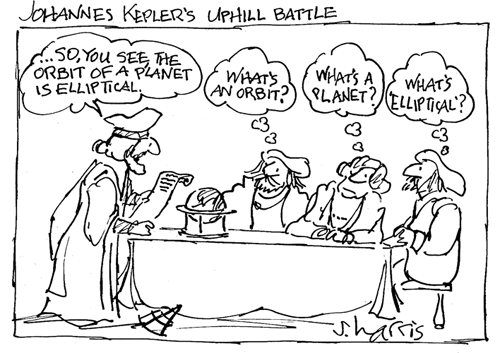
http://www.sciencecartoonsplus.com/gallery/astronomy/astron52_johannes-kepler.gif


Humans, in general, have something of a history of being fickle minded when it comes to theories on how things work, more so in the case of Astronomy. Ptolemy listed forty-eight constellations and believed in the geocentric theory. Along came Copernicus to burst his bubble. He came up with a theory that had the Sun at the centre of the Universe and not the Earth. We now know that neither of them are true. But at that point of time, the theory faced a good deal of opposition while still gaining popularity, as it was closer to the truth. Then came Kepler's laws, which gave us a detailed explanation of the motion of planets, Galileo's telescope, with which he was able to see Jupiter’s “ears”, Newton laws and finally, the Messier catalogue. THE MESSIER CATALOGUE which is still the most famous list of heavenly objects.


Soon enough, they got bored of just looking at the stars and standing there with their mouths gaping open. The emphasis then shifted to looking at the physics behind stars. It went beyond observation and cataloging. Till that time, as far as the people were concerned, stars were just humongous balls of cotton that had been set on fire.


https://blogger.googleusercontent.com/img/b/R29vZ2xl/AVvXsEhNWkfOCaNM6IOUH4U2aflfP39mSMXn0ooCjWR7-Ew6n8acF0v4vr9lcPxis6SHFM9sTz_qsaJO3mp0OHqu81BpMzkhZtomjvl8msSIKnWgFAmSn6v5lWJoY5VEigbkEPXTzP9P0_z-fCE/s1600/1237869378magic_fireball.jpg
OOH! Look. I’m holding a star! :)


And that’s when they analyzed Vega’s spectrum. Just like an excited kid with a prism pointed at the sun, the scientists had a look at the spectrum caused by light from Vega. And that’s when they went like OMGWTF?! The spectrum was different from the one that belonged to the sun. So our sun, was indeed unique, just like every other star out there. Spectroscopy provided a method of looking into stars, literally. There are three kinds of spectra: continuous, emission, absorption. Stars were upgraded from fiery cotton balls to hot balls of gas held together by tremendous gravitational forces. At such high temperature, the density is no barrier to using ideal gas equations, as the kinetic energy is still a lot higher than the potential energy. And the best part is, that you don't even have to be a genius to figure out the maths behind it. Sure, you might not have heard of some of the weird theorems and formulae that are used in the process, but down on the ground level, they are all just basic physics that we have all learned at school. Depending on how the dark or bright lines in a star’s spectrum were placed, you could tell what elements the star was made out of, the temperature of the star, how fast and where the star was moving, the density of the star and much, much more. 


https://www.cfa.harvard.edu/~jbattat/a35/images/figure_05-14.jpg
The different types of spectra that are used to study star


The color of stars are classified into 7 spectral types where(ironically) O, or blue  stars, are the hottest and M and K, or the red stars, are the coolest. Apart from that, stars are also divided into categories based on their sizes and luminosity. In the 1900s, two scientists came up with a temperature-luminosity graph for the stars, called the Hertzsprung, Russel diagram, or HR for short. They discovered that white dwarfs, giants and super giants didn't fit in in the same place as most of the other “normal” stars. 


http://www.le.ac.uk/ph/faulkes/web/images/hrcolour.jpg
The HR diagram, simplified


Naturally, observation and theorems followed and the quest goes on...

“...it was in the nature of things that we shall never know what stars are...”

...will it ever end?

Wednesday, November 9, 2011

Black Holes

The second topic in our series of discussions was Black Holes.The members of the club met on the terrace of Faculty Division III,BITS Pilani to conduct the discussion session. Following are  excerpts from the discussion.

BLACK HOLES

A black hole is a region of space with such a  high gravitational field that no matter or radiation can escape from it.Even light cannot escape its gravitational pull and hence, the term “black” is used to describe it.They are usually classified on the basis of their mass into two broad categories: Stellar-mass and Supermassive.
An artist’s rendition of a black hole

Stellar-mass black holes are formed when stars above approximately three solar masses(Tolman-Oppenheimer-Volkoff limit) collapse into a supernova. They grow in size by absorbing mass from the surroundings and merging with other black holes, leading to the formation of supermassive black holes with masses in the range of millions of solar masses. It is believed that the center of almost every galaxy contains a supermassive black hole.
Properties
An interesting theorem, popularly known as the “no-hair theorem”, describes the properties of black holes.It states that once a black hole achieves a stable state it has just three independent physical properties associated with it-mass, charge, and angular momentum. A consequence of this theorem is that once and object falls into a black hole and achieves a stable state, information about every quantity that cannot be measured outside a black hole is lost. This is known as the black hole information loss paradox.
The simplest black holes are the ones with no charge and no angular momentum. These are termed as Schwarzchild black holes. They are the only type of black holes that are spherically symmetric.
Structure

Structure of a stationary black hole
At the centre of a black hole lies the gravitational singularity, a point of zero volume and infinite density.  It is surrounded by the event horizon, the boundary at which escape velocity equals the speed of light and hence nothing can escape. The distance between the singularity and the event horizon is known as the Schwarzchild radius.
Structure of a rotating black hole
For rotating black holes the singularity takes the shape of a ring and the event horizon is surrounded by a region called the ergospehere in which it is impossible to stand still due to the process known as frame-dragging.
  Evaporation
Contrary to popular belief, the noted theoretical physicist and cosmologist, Stephen Hawking proved that black holes emit radiation in a perfect black body spectrum. This radiation, known as Hawking radiation, is emitted due to quantum effects and causes the black hole to lose mass and evaporate over time.
Observing a black hole
Black holes do not emit any direct signals that can be used for detecting them. The Hawking radiation is predicted to be very weak and is thus not useful for observational purposes. Black holes are, therefore, detected indirectly by observing their effects on the matter, energy or space around them.
Black holes accrete matter from their surroundings causing it to gain kinetic energy due to the gravitational pull and heat up. This causes the atoms to ionise and, at temperatures of a few million Kelvin, emit X-rays which may be detected by telescopes.
 Black holes are also often found in X-ray binary systems in which they accrete matter from the other star forming accretion disks. These can be easily observed as one of the stars is a regular star.The first strong candidate for a black hole discovered in this way was Cygnus X-1. 
A black hole absorbing matter from its companion star in an X-ray binary system forming an accretion disk

Various questions were put up in the discussion session and consequently topics like spherical symmetry of Schwarzchild black holes, Birkhoff’s theorem, the ergosphere, accretion and accretion disks etc. were discussed in more detail.
References

Tuesday, October 11, 2011

Spectra of Stars


SPECTRAL ANALYSIS OF STARS

Find out the temperature of a star and its chemical composition by analysing the light from the star!

Why should star light be different from white light?

We have a reason to expect star light will not just be the white light spectrum. There should be certain wavelengths missing.

The inner layers of the star are hotter and denser. They tend to radiate all colours like a hot solid, the upper layers act like a low density gas. The gas absorbs certain wavelengths depending on its composition which appear as absorption lines in the spectrum of the star.

(Here you can see the absorption lines in different regions of the spectrum of Betelgeuse)

Analysing the spectral lines

The absorption lines can be identified with individual chemical elements or molecular compounds by comparing their positions in the spectrum with those observed from pure sources in the laboratory. The intensity or “blackness” of the absorption line reflects on how much that particular chemical element was capable in removing energy from the spectrum. This depends mainly on two factors: The efficiency of the element and its abundance. Efficiency of the element depends on the number of electrons that the element has. For example, calcium shows a more intense line than hydrogen because calcium has more electrons for excitation. Hence this factor must be taken into consideration before interpreting the spectrum for the abundance of the chemical element.

The absorption coefficients also depend on the temperature of the star. Hence, you’ll find that few of the stars show very strong hydrogen lines while some do not show any hydrogen lines but show lines of titanium dioxide! To aid in understanding the composition of stars, astronomers classified the stars into spectral types. The main spectral classes are O, B, A, F, G, K, M. Here is an example of the spectrum for each spectral class.

O- Ionised helium

B- Neutral helium e.g. Spica, Pleiades.

A- Hydrogen e.g. Sirius, Deneb, Altair, Vega.

F-Weaker Hydrogen, ionised metals. e.g. Canopus, Polaris.

G- Still weaker hydrogen, ionised and neutral metals e.g. Capella, Sun.

K- Weak hydrogen, neutral metals e.g. Arcturus, Aldebaran.

M- Neutral molecules and metals e.g. Betelgeuse, Antares.

Estimating temperature of the star

The intensity vs. wavelength length plot of the spectrum roughly follows the pattern of a black body radiation. The easiest way to find out the temperature of the star is to find out the wavelength of the maximum radiation and apply Wien’s displacement law to get the temperature. But Wien’s law lets us quantify the temperature only for Planck-like spectra. Stars don’t exactly have a Planck-like spectrum.

The best way to estimate its temperature is from the H-R diagram which a plot of all the known stars graphed according to absolute visual magnitude on the vertical axis and spectral class on the horizontal axis. The graph is characteristic and is divided in the main sequence stars, the red giants, the blue giants and white dwarfs.


References

http://stars.astro.illinois.edu/sow/spectra.html

http://hyperphysics.phy-astr.gsu.edu/hbase/starlog/staspe.html

http://www.ucolick.org/~bolte/AY4_00/week5/star_mass.html